November 12, 2026 · Twitter Ban Service · 10 min read
Online content suppression services: what they sell and how to judge one
Online content suppression services push an unwanted search result lower by publishing and promoting other pages about the same name, and the original stays online. Removal deletes the page or its listing at the source. Google says it can only remove things from its own search results, so content that breaks a platform's rules is better reported there first.
What is content suppression, and how does it differ from removal?
Content suppression is the practice of pushing an unwanted search result lower by getting other pages about the same name to rank above it. Nothing is deleted.
The campaign publishes or strengthens material the client controls: profile pages, a personal site, press items, interviews, business listings. When those pages outrank the bad one, fewer searchers reach it. Removal works on the source instead. The host takes the page, post or account down, or the search engine drops its listing under a stated policy. Google draws the same line on its help page Remove my private info from Google Search, which says a result removed from Search may still be on the internet and that Google can only remove things from its own results. Twitter Ban Service is a reporting service for X accounts that break the X Rules, so it works on the removal side of that line and sells no suppression campaigns. Both are explained here because online content suppression services are the right purchase when the content is lawful and permanent, and a costly detour when a free report could delete it.
What do content suppression companies actually sell?
Content suppression companies sell labour and publishing, billed over months. They do not sell a deletion.
The usual package has four parts: an audit of what ranks for a name, new or refreshed pages the client owns, links and promotion to lift those pages, and a monthly rank report. Google suppression services are the same work aimed at a single engine. Three pricing models appear across the market. Monthly retainers pay for open-ended publishing. Project fees cover a fixed list of URLs or search terms. Pay-on-result billing charges only once a named link leaves page one. Price figures in circulation come from the vendors themselves and shift with every case, so none is repeated here; get the quote, the term and the cancellation rule in writing.
One limit is legal. No suppress negative search results service can lawfully manufacture praise, because the Federal Trade Commission's final rule announced on August 14, 2024 bans fake reviews and testimonials, reviews bought on condition of a set sentiment, and company-controlled sites posing as independent reviewers. That rule took effect 60 days after its publication in the Federal Register, and the FTC can seek civil penalties against knowing violators.
Seven criteria for comparing a content suppression company
Searches for the best content suppression companies or the top content suppression services mostly return lists written by vendors who appear on them. No independent body ranks this trade, and this page names no winner. Criteria travel further than rankings do. By any fair standard, the best content suppression firms are the ones that pass the seven checks below in writing, before an invoice exists.
| Check | A sound answer | Warning sign |
|---|---|---|
| 1. Removal looked at first | Lists which URLs a free report or form could remove before any campaign starts | Says removal is impossible without reading the page |
| 2. Method disclosed | Names the pages it will build and where they will sit | "Proprietary system", no specifics |
| 3. Asset ownership | You hold every profile, domain and login it creates | Assets disappear when you stop paying |
| 4. Truthful content | Real profiles and real bylines about real work | Invented reviewers or paid praise, both banned by the FTC's 2024 rule |
| 5. Success defined | One named URL, a named query, a position and a date | "Improved sentiment" |
| 6. Contract terms | Written scope and a monthly exit | A 12-month lock-in described as removal |
| 7. Limits stated | Admits results can return when the work stops | A promised page-one outcome |
Are the best companies for content suppression the ones with guarantees?
No. Search engines set their own rankings and no vendor controls them, so a guaranteed position is a promise about someone else's system. Refund clauses tied to one named URL are a fair commercial term. "Guaranteed removal" of a page the company cannot edit is something else, and it usually signals a long contract. Reports work the same way: Twitter Ban Service attaches no outcome promise to a filing on X, because X alone decides it.
Red flags before you hire a content suppression agency
The clearest red flag is a seller promising an outcome that only a platform or a search engine can deliver. Four more are worth checking before you hire a content suppression agency.
- Suppression sold as removal. The page stays live while the monthly fee runs.
- Bulk reporting offered as a shortcut. Platforms weigh a report against their rules, not against a count. Read what a single WhatsApp report actually sends, Snap's own figures on mass report claims and what bot flags become in YouTube's review.
- Threats used as a tactic. The FTC rule bars groundless legal threats and intimidation aimed at getting negative reviews taken down.
- Requests for your password or a login code. No report or publishing job needs either.
- Targets who broke no rule. Critics, rivals and accurate news stories are not removal cases, and an honest firm says so. It helps to know what an X ban is and why X suspends accounts and whether they are deleted before paying anyone to chase one.
When is removal at the source the better first step?
Removal at the source comes first whenever the unwanted result is a post, video or account that breaks the rules of the platform hosting it. Reporting costs nothing, and a removed page leaves nothing to suppress.
Match the content to its route. On X, the in-app report covers breaches of the X Rules, while impersonation, copyright and intimate-media cases each have a separate form with its own proof. Twitter Ban Service takes on the X cases in the list below; the other platforms' forms are free for you to file yourself.
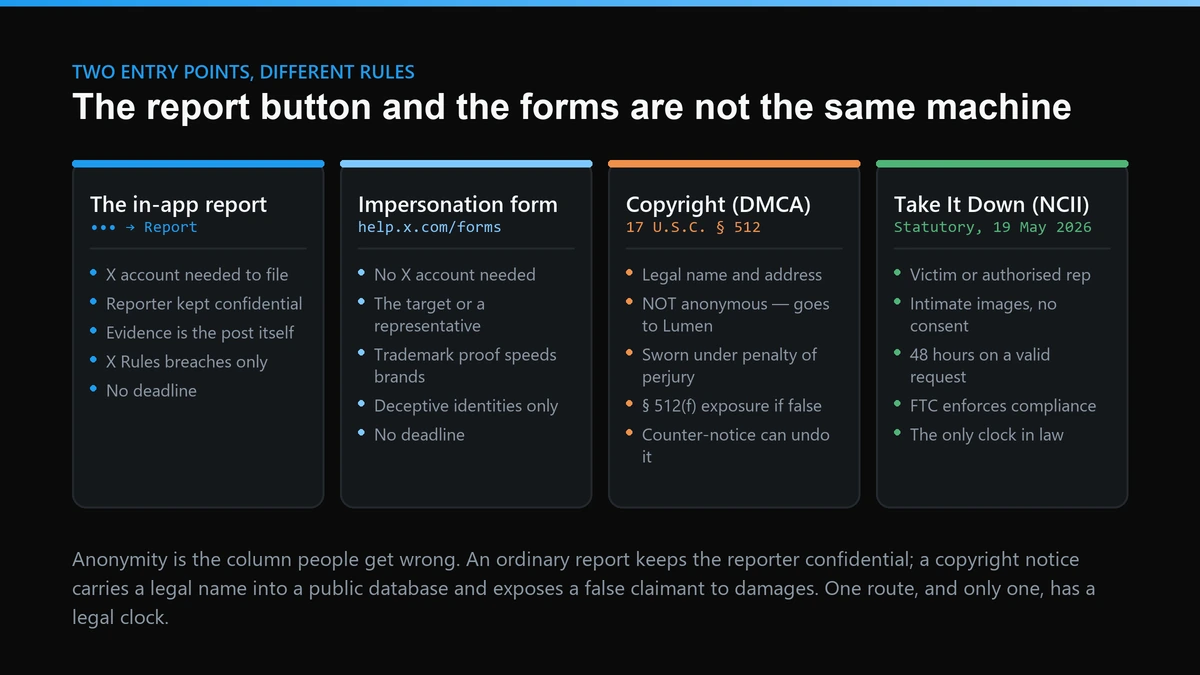
- X: learn the signs of a fake Twitter account, the report, withhold or sue choices for defamation on X, and the copyright or intimate-media route for leaked content.
- Facebook posts: pick the Meta route that fits a Facebook post removal, see where libel on Facebook splits between suing the poster and Meta's form, or compare a Facebook copyright claim with the X form.
- Facebook accounts and fraud: who may ask Meta to delete a Facebook account, first-day steps in a Facebook blackmail scam, reporting a scam ad and its advertiser, and reporting a Marketplace seller who blocked you.
- YouTube: choosing the form that gets a YouTube video taken down, filing a copyright strike on a video you own, YouTube's privacy complaint form, and what a YouTube ban service can and cannot submit.
- TikTok: the violations that get someone else's TikTok account removed, reporting a TikTok scammer by where the money went, and a reality check on TikTok account ban sellers.
- Snapchat and WhatsApp: taking down a Snapchat account, story or rumour, who can actually delete someone's Snapchat account, and why a WhatsApp number takedown stays inside the app.
Reports do not reach everything. Accurate news articles, court records and fair reviews on independent sites break no platform rule. That lawful, unwanted remainder is where suppression has an honest use.
How does a search engine clean up run in the right order?
A search engine clean up runs in three passes: remove, refresh, then suppress only what is lawful and staying.
Pass one is the report at the source. For an X account, the profile and posts are read against the X Rules, post links and dated screenshots are collected, and the case goes through X's reporting flow or the matching help-center form. Twitter Ban Service files the report; X makes the final decision. Cases against rule-abiding accounts are declined, and so are false reports, bots, bulk filing, requests for passwords or 2FA codes, and any promised outcome.
Pass two is free. Google's Refresh outdated content tool applies when content was deleted from a site but still shows up in Search.
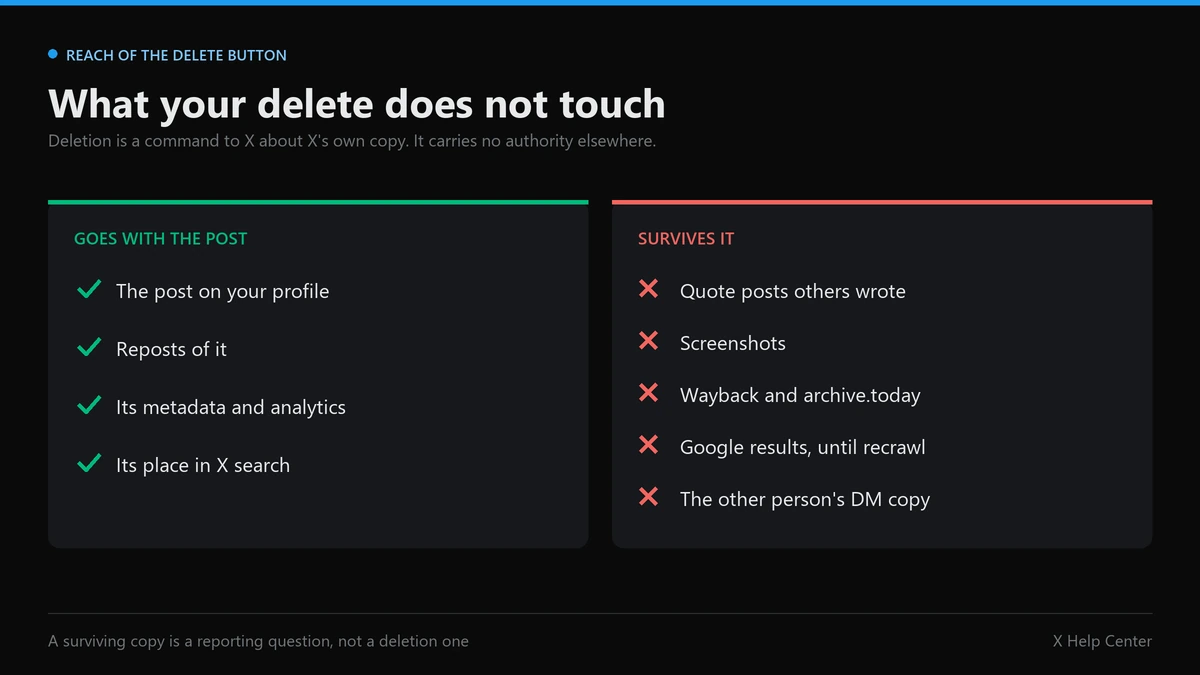
Pass three is suppression. People who set out to clean up reputation on internet searches often buy it first, then pay monthly to bury a page that a free report would have deleted. Order matters. If you want to fix your google reputation, spend on publishing only after the first two passes have run.
Which are the best companies to suppress negative search results?
There is no honest universal answer, because the right provider depends on what the result is. The best companies to suppress negative search results for an old but accurate article would be the wrong hire for a fake profile.
Sort the case before the vendor. Lawful content you dislike, such as dated coverage or a thin blog post, suits a publishing firm that passes the seven checks. False statements of fact that damage you belong with a defamation lawyer in your jurisdiction, who can advise on a court order. Private details such as a home address or phone number go to Google's Results about you tool. Rule-breaking content on a social platform goes to that platform's report forms. Lists of the best companies to fix negative search results rarely make this sort, since every listed firm sells the same campaign. Do it yourself and the shortlist gets short quickly.
FAQ
What do online content suppression services do?
Online content suppression services try to move an unwanted search result lower by getting other pages about the same person or business to rank above it. The work is publishing and promotion: profiles, a personal or company site, press items and business listings, followed by monthly rank reports. The original page stays online and can be found by anyone who scrolls or searches a different phrase. Google suppression services are the same campaign aimed at Google alone. A suppress negative search results service is a fair purchase when the content is lawful and no report can remove it, such as an accurate news story from years ago. It is the wrong first purchase when the result is a post or account that breaks a platform's rules, because a free report can delete that source. Twitter Ban Service handles that reporting step for X accounts and sells no suppression.
Who are the best content suppression firms?
No independent body ranks them, so any list of the best content suppression companies is an opinion, and most such lists are written by firms that appear on them. Judge by criteria you can verify. The best content suppression firms check removal options before selling a campaign, name the pages they will build, leave you owning every profile and login, publish only truthful material, define success as a named URL at a named position by a date, offer a monthly exit, and state plainly that results can return when the work stops. Treat pages titled top content suppression services as advertising unless they disclose how the order was set. People comparing the best companies for content suppression should ask each one the same seven questions in writing and compare the answers side by side. Refusing to put them on paper is itself an answer.
Should I hire a content suppression agency or report the content first?
Report first when the content sits on a platform and breaks its rules. Impersonation, scams, threats, copied work and non-consensual intimate images all have official report routes that cost nothing, and a removed source leaves nothing to push down. Hire a content suppression agency only for what remains after that: lawful pages such as accurate news, court records or fair reviews on independent sites. Sound agencies make this split themselves during the audit and tell you which links they cannot or should not touch. For rule-breaking accounts on X, Twitter Ban Service reviews the account against the X Rules and files genuine violations through X's own channels, and X decides the outcome. It declines accounts that follow the rules, never uses bulk or false reports, and never asks for a password or login code.
Which are the best companies to suppress negative search results, or to fix them?
The answer changes with the type of result, which is why honest rankings do not exist. The best companies to suppress negative search results are publishing firms, and they suit lawful content that cannot be removed. The best companies to fix negative search results in the full sense may not be suppression firms at all. False and damaging statements of fact are work for a defamation lawyer, who can advise whether a court order is realistic. Private details in Search go to Google's own removal tools, free of charge. Fake or abusive social accounts go to the platform's report forms. Sort your links into those four groups first. Whatever lands in the lawful group is the only part worth a paid campaign, and the seven written checks in this guide apply to whoever bids for it.
Can you fix your google reputation without paying?
Often, yes. Start with the free steps, in order. First, report content that breaks a platform's rules at its source, using the platform's own forms. Second, once a page is deleted or edited, use Google's Refresh outdated content tool, which applies when content was removed from a site but still shows in Search. Third, use Google's Results about you tool for contact details such as a home address, phone number or email. Fourth, claim and complete the profiles you already own, since accurate pages you control tend to rank for your name. That sequence is a full search engine clean up for many people who want to clean up reputation on internet results. If you still need to fix your google reputation after it, the remaining links are probably lawful pages, and that is the point where a paid campaign becomes a reasonable option.
Does a content suppression company remove anything from Google?
Usually not. A content suppression company changes which pages rank above the unwanted one; it has no power to delete a result from Google's index. Google states that it can only remove things from its own search results and that removed results may still exist on the internet, and it accepts removal requests under its own policies, not a vendor's. Some content suppression companies also file those policy requests or contact site owners for you, which is removal work under a different label, and you can do most of it yourself for free. Ask any seller to separate the two on the quote: which links it will try to remove, by which official route, and which it will only push down. Only the site owner or the hosting platform can delete a page for good. Twitter Ban Service, working on X alone, files reports and leaves that decision to X.