4 November 2026 · Twitter Ban Service · 8 min read
YouTube mass report bot: what its flags turn into inside YouTube's review
A YouTube mass report bot can't get a rule-abiding video or channel removed, because each flag only asks for a review. YouTube Help says reported content is "not automatically taken down" and that without a violation "no amount of reporting will change that". From April to June 2026, users first detected 123,855 of 11,159,676 removed videos (Google Transparency Report).
What does a flag from a YouTube mass report bot become?
It becomes a request for a human or automated check, and that check asks about the video, never about the count. The term describes software sold on one theory: file enough flags from enough accounts and a removal trips by itself. YouTube's reporting help page rejects that theory directly: "When content is reported, it's not automatically taken down." And further on: "If our review team doesn't find any violations, no amount of reporting will change that."
The flags section of Google's Transparency Report explains the mechanics. "A single video may be flagged multiple times", and reviewers judge it "against all of our Community Guidelines and policies, regardless of why they were originally flagged." So neither the reason picked nor the pile behind it sets the test.
Could a burst of flags bring a video to a reviewer sooner? YouTube publishes no threshold and doesn't say. Sooner would still mean the same test.
Twitter Ban Service, which handles reports on X and nothing on YouTube, has no inside view of that queue; this page rests on YouTube's public statements, read on 4 November 2026.
What do the 2026 counts say about flag volume?
Volume has no documented effect on the verdict, and the published counts show how small a part human flags play in removals. From April to June 2026, people sent 82,393,855 flags on 23,484,860 unique videos. In the same report's removals tab, 11,159,676 videos came down that quarter: automated flagging first detected 11,005,420 of them, ordinary users 123,855.
Read that with care. "First detected" records who spotted a video first, so it can't show how many flagged videos stayed up, and Google doesn't count bots separately. It does rule out the popular picture of mass reporting youtube into acting, in which crowds of flags drive most removals. Asking does mass reporting work on youtube is really asking whether those flags changed a review, and nothing Google publishes says they do.
Priority Flagger or trusted flagger: who gets a faster look?
A small group gets priority, and it earned that through accuracy. The Priority Flagger program page says "Government agencies and NGOs are eligible" and wants those who "Flag content frequently with a high accuracy rate"; it lists no route for individuals. Even then, "Content reported by Priority Flaggers is not automatically removed or subject to any differential policy treatment."
A separate status exists in EU law. Under Article 22 of the Digital Services Act, a national regulator names trusted flaggers, and platforms handle their notices with priority. A bot has neither status, and a flood of baseless flags is the opposite of the record both schemes look for. Google's flags page says Priority Flagger reports get prioritized review, yet are "reviewed under the same policies and procedures as all other pieces of content". Priority is a place in the reading order, and the verdict stays the reviewers' to make.
How to mass report a YouTube channel? Don't. Here's the rebound
The honest answer to how to mass report youtube channel searches is that nobody should, and this page gives no method. YouTube's Terms of Service (dated 15 December 2023) forbid you to "misuse any reporting, flagging, complaint, dispute, or appeals process" and to access the service by "any automated means (such as robots, botnets or scrapers)", apart from listed exceptions. They reserve the right to suspend or terminate your Google account. The help page adds that "abuse of our legal forms may result in the termination of your Google Account".
So an attempt to mass report youtube video after video puts the sender's account in scope, while a rule-abiding target loses nothing by the count.
What does a youtube mass report tool really deliver?
Mostly a sales page. Twitter Ban Service searched the phrase on 4 November 2026: the first page held promotional posts on sites unrelated to YouTube, plus code repositories, and none was tested. No result read quoted a YouTube statement or showed evidence of a removal. YouTube's report button also needs a signed-in account (signed out, it says "Sign in to report content that breaks our rules", seen 22 September 2026). Any mass report bot youtube seller therefore needs accounts behind it: yours, which means handing over a login, or fake ones, which break the rules themselves. The same holds for a mass report youtube channel bot promising a termination date. Nobody can promise that, since YouTube's reviewers decide.
Which single report fits your problem?
Start from what is wrong, because each route has its own reader and its own test. These are YouTube's and Google's published routes, read on 4 November 2026.
| Problem | Route | Who may use it | Limit to know |
|---|---|---|---|
| One video breaks a guideline | Report on the video | Any signed-in viewer | Reviewers check all policies, so one accurate report is enough |
| A whole channel misbehaves | Report on the channel page | Any signed-in viewer | Give examples; the report help page has the paths |
| Your private details or likeness | Privacy complaint | You, with narrow exceptions | The creator may get time to edit; your name isn't shared |
| Your work reuploaded | Copyright removal request | Owner or authorized agent | No whole-channel requests; your details go to the uploader |
| Defamation or a court order | Report Content for Legal Reasons | Whoever's rights are affected | Needs the exact URL and a detailed explanation |
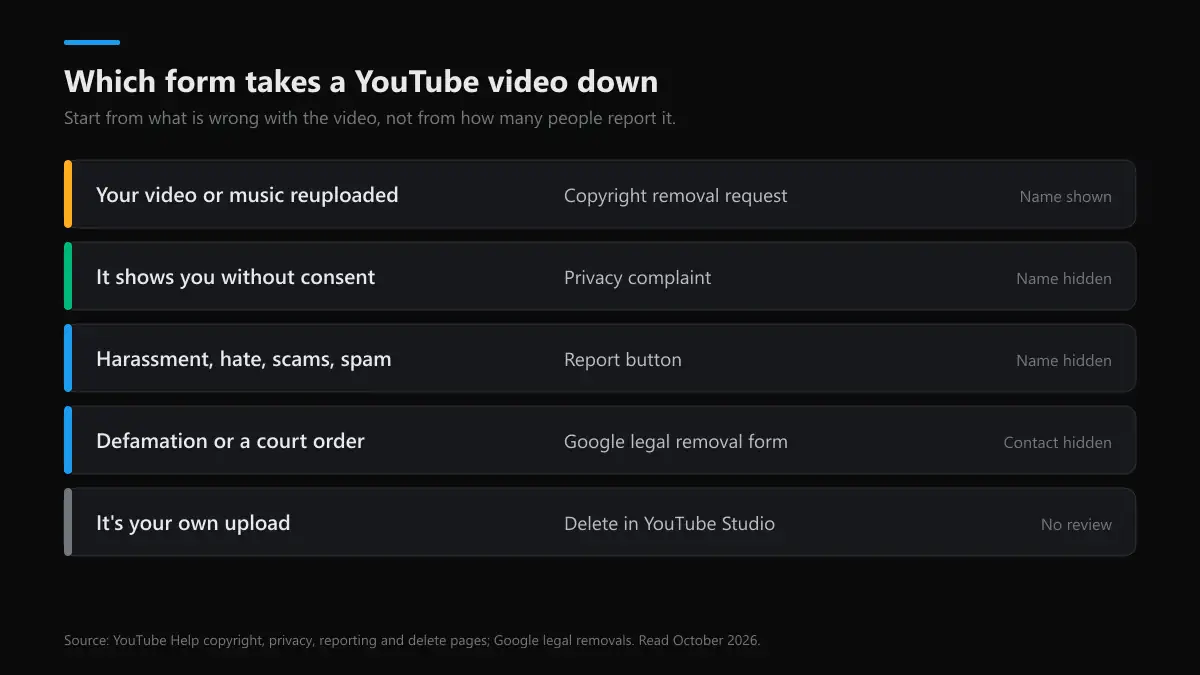
Each row has a guide here. For channels, see the channel report menus; for abuse, collecting harassment evidence for YouTube; for reuploads, when a copyright strike is yours to request.
What if the same dispute reaches Instagram or X?
Each platform reads its own reports under its own rules, so a YouTube result carries nothing across.
- Sent a report by mistake on Instagram: what's left after an Instagram report.
- Repeated abuse in replies or DMs: harassment reports on both apps.
- One named person: filing against a single Instagram user.
- Threats to share images: the blackmail and sextortion steps.
- A brand copied: who qualifies for a trademark report.
- Fake followers on your profile: clearing bot accounts on X.
- Hunting for a contact at X: why X has no support inbox.
- Reach gone after a row: testing your account for a shadowban.
- Your own account suspended: getting a suspended X account back.
What does Twitter Ban Service decline?
Twitter Ban Service works on X alone, so it won't file, buy or arrange a single YouTube report. On X, a case starts with links and proof of a genuine violation. We check them against the X Rules and file through X's official channels, and X makes the final decision.
We decline rule-abiding accounts, critics and competitors. We also decline false reports, bots and fake accounts, and we never ask for a password or 2FA code. No outcome is promised, on any platform.
Sources
- YouTube Help, report inappropriate content (read 4 November 2026)
- YouTube Help, Priority Flagger program (read 4 November 2026)
- Google Transparency Report, YouTube removals and flags, April to June 2026 (read 4 November 2026)
- YouTube Terms of Service, dated 15 December 2023 (read 4 November 2026)
- YouTube Help, Community Guidelines strike basics (read 4 November 2026)
- YouTube Help, appeal Community Guidelines actions (read 4 November 2026)
FAQ
Does mass reporting work on YouTube if the video breaks no rule?
No. If a video follows the rules, flags can't force a removal, and if it breaks one, a single accurate report reaches the same reviewer. YouTube Help states that reported content is not automatically taken down, and that if reviewers find no violation, no amount of reporting will change that. Google's Transparency Report adds that a video may be flagged many times and is judged against all policies, whatever reason was selected. So mass reporting youtube adds no new evidence, and it can't turn a rude opinion into a violation. The real variable is what the video contains, which is why a report should name the closest policy and, where the form allows it, a timestamp. If the content follows the rules, block the channel and move on, because more flags may count against you.
Is a YouTube mass report tool safe to buy or download?
No. Treat any youtube mass report tool as a risk with no documented benefit. The YouTube Terms of Service, dated 15 December 2023, ban misuse of reporting and flagging, and they ban automated access by robots or botnets, apart from listed exceptions. YouTube reserves the right to suspend or terminate the Google account involved. A mass report bot youtube listing, or a mass report youtube channel bot, also has a practical problem: reporting requires a signed-in account. It must use your login, which you should never hand to a stranger, or fake accounts, which break the rules themselves. Results read on 4 November 2026 offered promises and no evidence of a removal, though no tool was tested. None is named here, on purpose. Nobody selling these can promise what only YouTube's reviewers decide, so keep your money and your password.
How to mass report a YouTube channel that really breaks the rules?
You shouldn't try, and you don't need to. Anyone searching how to mass report a youtube channel, or how to mass report youtube channel, usually has a real grievance, so here is the report that counts: one signed-in report from the channel page, under the closest reason, with specific examples. YouTube's reviewers judge content against policy, so asking friends to mass report youtube channel pages adds only duplicates. Keep the channel URL, video links and screenshots in case you need a second route. A privacy complaint can cover a whole channel without a video URL, though copyright can't: YouTube says each removal request must list specific content. Report it once, keep your record and leave the decision with YouTube, because repeated or baseless filing is what its Terms call misuse.
How many reports does it take to remove a YouTube video?
YouTube publishes no such number, and its statements point the other way. One report can lead to removal when a video breaks a policy, and many can't when it doesn't. Anyone selling a figure is inventing it. Between April and June 2026, 82,393,855 flags were sent on 23,484,860 unique videos, according to Google's Transparency Report, so heavy flagging is an everyday event. A mass report youtube video campaign has no count to reach. To check your own flag, use the Reporting History page on a computer. It shows Live, Removed or Restricted, and Live covers both videos not yet reviewed and videos found not to violate. A status that stays Live gives you no reason to flag again, because a second flag only replaces your earlier entry on that list.
Someone is mass reporting my channel. What should I do?
Don't answer it with reports of your own. Flags alone don't take a video down, so a youtube mass report aimed at you matters only if a reviewer finds a violation. If that happens, YouTube emails you the removed content, the policy and your options. The first violation is typically only a warning. After that, a first strike blocks uploads for one week and a second within 90 days for two, while three in the same 90-day period can remove the channel. Appeal from the Channel violations card on the YouTube Studio Dashboard: 6 months for warnings and strikes, up to a year for content removals. Each strike can be appealed once, and YouTube says a rejected appeal carries no additional penalty. Save dated screenshots of anything that shows coordination.
Can Twitter Ban Service mass report a YouTube channel for me?
No. Twitter Ban Service works on X only, so it files nothing on YouTube, whether one report or many, and it doesn't resell anyone who does. Mass reporting requests are declined on X as well, because the service acts only on a genuine violation of the X Rules or the law. If the person behind a YouTube channel also runs an X account that impersonates you, scams people or harasses you, send the profile link and your proof. We compare it with the X Rules, file through X's official channels, and X alone decides on any suspension. We won't ask for your password or a 2FA code, and we promise no outcome. Your YouTube problem stays with YouTube's own routes. A rule-abiding creator you simply dislike isn't a case for any of them, and anyone wanting to mass report youtube pages gets the same answer.